


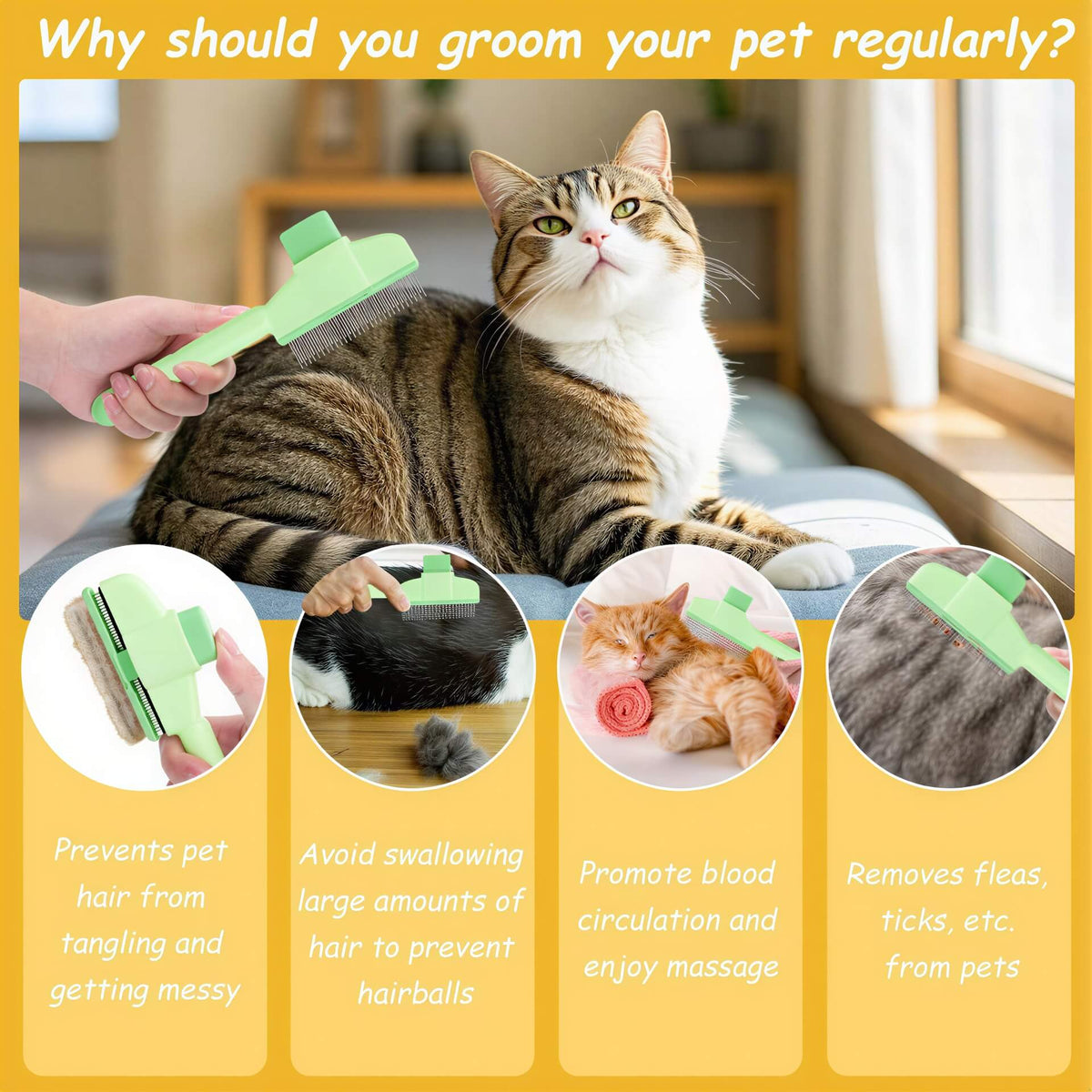
If this sounds familiar
You brush her every day and the groomer still found mats behind her ears and under her legs.
The brush fills up after two strokes and you spend longer picking hair out of it than grooming.
Her coat looks fine from the top and feels solid when you push your fingers into it.
Why you'll love it
The top of the coat looks beautifully groomed. That's exactly the problem.
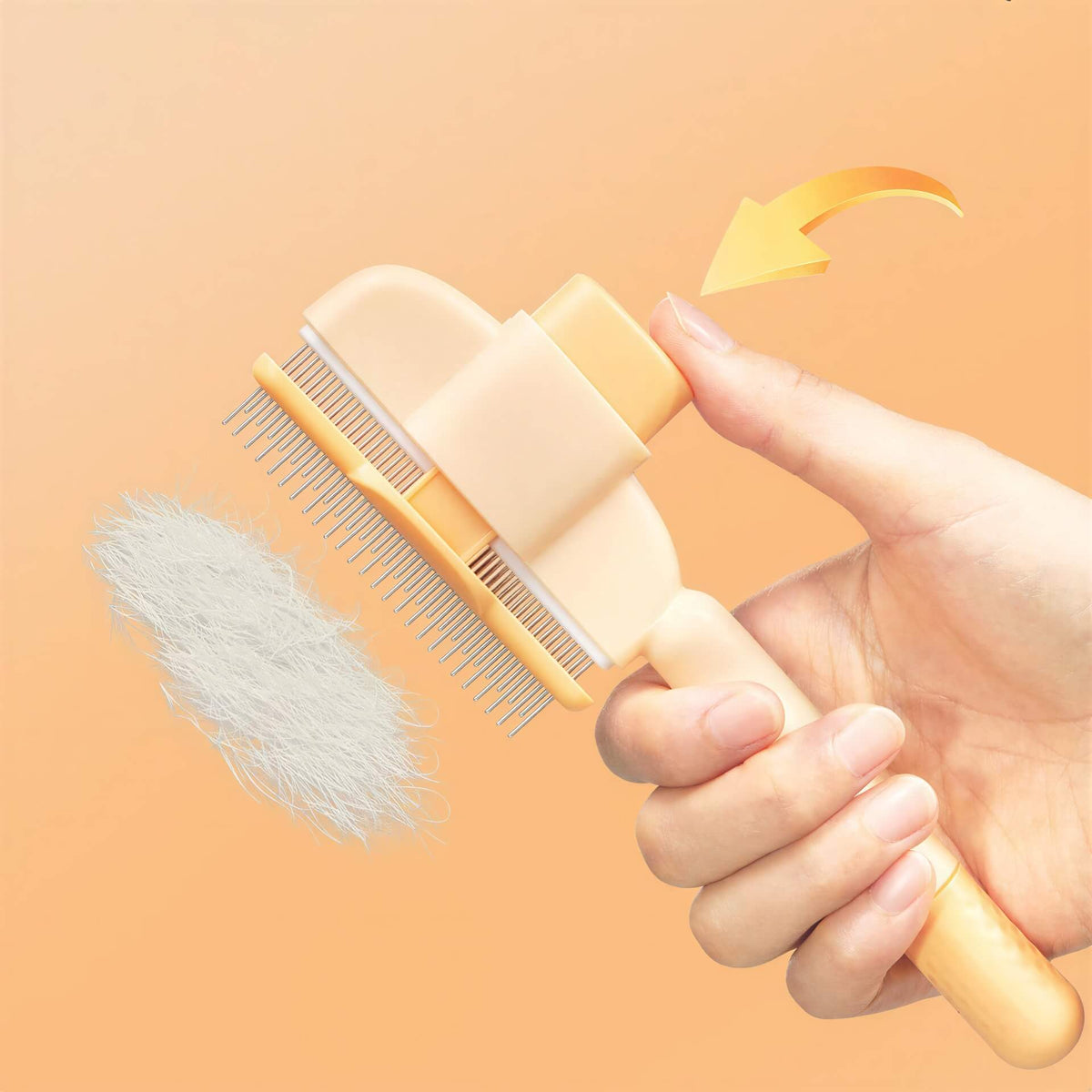
One press and it's empty
The pins retract and the collected hair lifts away in a sheet. Sounds minor; it's the difference between a brush you use and a brush that lives in a drawer.
Reaches where mats start
Fine pins get down through the top layer to the base of the coat, which is the only place matting can actually be prevented.
Five minutes, three times a week
Enough to stop a long or curly coat matting at all - which is the difference between a trim and having the whole coat shaved off.
Light enough for a cat
Fine pins and almost no pressure needed. Cats have thinner skin than dogs, so the tool that suits them is one you barely have to push.
Mats don't form where you can see them.
A coat mats from the bottom up. The hair closest to the skin tangles first, binds into a pad, and tightens — all underneath a top layer that brushes out smooth and looks perfectly cared for. By the time matting is visible from above, it's usually solid enough that a groomer will have to shave it off rather than comb it out.
How it works
Why coats mat underneath a surface that looks fine
Will it fit
pins retract, hair lifts off
long, curly and double coats
five minutes a session
let the pins do it
Best on long, curly and double coats — the ones that mat. On a short single-coated breed there's little for it to do and a glove or a rubber mitt is kinder. For a cat, use light pressure and short sessions; their skin is thinner than a dog's and tears more easily.
Simple to use
Check first, work from the skin out, keep it short.
Feel for mats before you start
Run your fingers through the coat down to the skin, especially behind the ears, under the legs, around the collar and at the base of the tail. Anything solid gets cut out or left to a groomer - never brushed through.
Part the coat and work from the skin out
Hold a section up with one hand so you can see a line of skin, then brush downward and outward from the base of that line. Move up an inch and repeat. Barely any pressure - if you are pushing, you are scraping skin rather than combing coat.
Short sessions, often
Five minutes three times a week keeps a long coat clear. One long session a month does not, because mats form in between. Press the release to clear the pins whenever they fill up.
Great for
- Long-coated cats - Persians, Maine Coons, Ragdolls
- Curly and continuously growing coats - poodles, doodles, bichons
- Double-coated dogs during a moult
- Anyone whose groomer keeps finding mats they didn't know about
- Pets who've had a coat shaved off and you'd rather it didn't happen again
- Owners who gave up on brushing because cleaning the brush was worse than the job
Not ideal for
- Short single coats. There's little for it to reach - a grooming glove or rubber mitt is kinder and does more.
- Mats that are already solid. Brushing one pulls the skin underneath and hurts badly - cut it out flat against the skin or let a groomer take it off.
- Heavy-handed use. Slicker pins are fine wire and pressing hard scrapes skin raw.
- Pets with sore, broken or irritated skin - see a vet before grooming the area.
- The washing machine. There's a mechanism inside the head.
Not sure? Send us your pet's measurements and we'll tell you.
Line brushing, mats and brush burn
Why the top layer lies to you
A coat mats from the skin outward. The fine hair closest to the body tangles, collects more hair, and compacts - under a surface that still brushes out smooth. Daily brushing of that surface feels like staying on top of it and does almost nothing for the layer that matters, which is how owners end up genuinely shocked when a groomer says the coat has to come off.
How to line brush
Part the coat with one hand so a line of skin shows, brush outward from the base of that section, then move up an inch and do the next. Work in rows up the body. It is slower than brushing over the top and it is the only technique that reaches the base. Groomers do it on every long coat, every time.
Brush burn is real
Slicker pins are fine bent wire set close together. Used lightly they slide through coat; pressed hard they drag across skin and leave it red and sore, sometimes grazed. The pressure that feels productive is usually too much. Let the weight of the brush do it and go over an area twice rather than once hard.
When a mat has to be cut out
If you can't slide a comb under it, don't brush it. Slide blunt scissors flat against the skin and cut the mat away, or have a groomer clip it off. Pulling at a solid mat drags the skin with it - which is painful enough that a pet who experiences it once will fight every grooming session afterwards.
Product details
What's included
1 x self-cleaning slicker brush
Care & maintenance
Press the release to clear the pins after every use and wipe the pin bed with a dry cloth. Don't put it in the washing machine or soak it — there's a retraction mechanism inside the head. If you need to wash the pins, rinse them briefly and stand it pins-down to dry.
Shipping
Free on every US order. Most arrive within 7-12 days. Tracking by email as soon as it ships.
Returns
Damaged, faulty or wrong item - tell us within 7 days and we'll replace or refund in full. We can't take change-of-mind returns, which is why every page says who it isn't for.
Ask before you buy
Send your pet's measurements, breed and age and we'll tell you honestly whether this suits - including when it doesn't.
Questions
Before you order
I brush her every day and she still gets mats. Why?
Almost always because the brushing is going over the top of the coat rather than through it. Mats form at the skin, under a surface that still looks groomed. Part the coat so you can see a line of skin and brush outward from there - five minutes of that beats twenty minutes over the top.
Will it hurt my cat?
Not with light pressure. The pins are fine wire and they are meant to slide through coat, not be pushed against skin. Cats have thinner skin than dogs, so use almost no pressure and keep sessions to a few minutes.
Can I brush out a mat that's already formed?
If a comb slides under it, yes, working from the outer edge inward in small sections. If it is solid against the skin, no - brushing it drags the skin underneath and genuinely hurts. Cut it out with blunt scissors held flat, or have a groomer clip it off.
How is this different from the grooming gloves?
The gloves are for pets who won't tolerate a brush at all, and they work on short coats. This reaches the base of a long or curly coat, which is where matting starts. Different jobs - a lot of owners of long-coated pets end up with both.
Does it work on a short-haired cat?
There's not much for it to do. A short single coat doesn't mat, and a rubber mitt removes loose hair more comfortably. Save this for long, curly or double coats.
How do I clean it?
Press the release and the hair comes away in one piece. Wipe the pin bed with a dry cloth. Don't machine wash it or leave it soaking - there's a retraction mechanism inside the head.
How often should I use it?
Five minutes three times a week for a long or curly coat. Daily during a heavy moult. Little and often is what prevents matting; one long session a month doesn't, because the coat mats in between.